How a Family Cxan Shape U in Bad Situations in Life
The unexpected ways children change their parents
(Image credit:
Getty Images
)
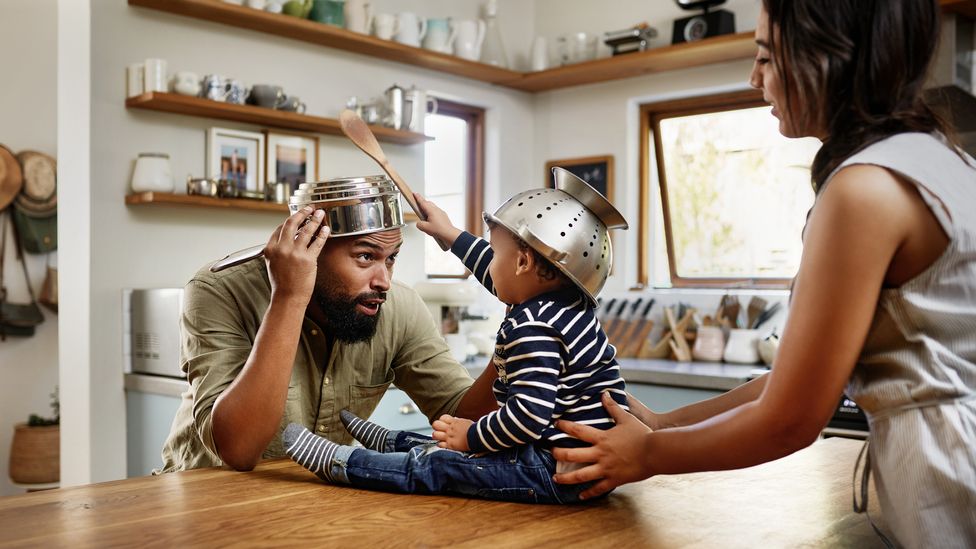
We don't steer our children almost as much every bit we might think – but they shape usa all the fourth dimension. Agreement this could make parenting less stressful, explains Melissa Hogenboom.
I
I never idea that at four years old, our daughter would still interrupt our slumber, which feels especially unfair now that her younger brother sleeps well.
I once tried to plead with her not to wake united states of america upwards, explaining that it would make us tired the next 24-hour interval. She thought about this for a moment and and so replied: "Just that's OK if y'all are tired considering you can drink coffee tomorrow."
It was another stark reminder of how much she has changed my daily schedule and habits, including my increasing java consumption. But as a growing body of scientific research shows, she may in fact be influencing me on a much deeper level, far beyond my slumber patterns. Meanwhile, my own efforts at influencing her may non be virtually equally impactful as I'd similar to believe.
Understanding just how much our children shape us – and how much (or piffling) we shape them – tin can burst the illusion that as parents, we are in full control. But information technology could likewise dispel the stressful feeling that every conclusion we make equally parents will affect them in some irreversible mode, and might even open the door to a unlike kind of family life.

Embracing our children's impact on united states of america can make parenting more relaxing (Credit: Artyom Geodakyan\TASS via Getty Images)
Children begin influencing us even before they are born: we program for their inflow and accommodate our lives to welcome them. As babies, they straight our sleep and, as a side effect, our moods. We know for case that parents of irritable babies are more stressed, sleep less and may even think they are parenting badly. In a vicious cycle, stress and lack of slumber tin then contribute to an increased risk of parental depression and feet.
But there's more than. Many studies testify that a child's innate personality shapes how we parent them.
"Of course, parenting a kid is a really different story depending on who the child is," says child psychologist Anne Shaffer at the Academy of Georgia. "I know clinically we see that parents will come to usa because they're having challenges with a kid and they'll say, just this worked for my older kid, and we're like: 'This child is a whole different person and then they have a whole different set of needs.'"
Focusing as well much on how we parent therefore puts a "tremendous corporeality of force per unit area on parents, and it also creates this illusion that if only we do all the right things, we will be able to mould our children into these happy, healthy, successful adults that we all desire them to eventually be," says Danielle Dick, author of The Child Code and a geneticist at Virginia Democracy University.
The reality may exist more complex. For a start, there is mounting evidence that children influence their parents, as well as the other way around – a phenomenon called "bidirectional parenting".
Family Tree
1 large report looking at bidirectional parenting and featuring over one,000 children and their parents, concluded that the child'south behaviour had a much stronger influence on their parents' behaviour than the other way around. Parents and their children were interviewed at historic period eight and once again over the subsequent five years. Parental command, the study found, did not change a child's behaviour, merely a child's behavioural issues led to less parental warmth and more than control.
Research also shows that when children demonstrate challenging behaviour, parents may withdraw or use a more authoritarian (strict and cold) parenting fashion.
Similarly, parents of adolescents with behavioural issues act with less warmth and more hostility. The opposite occurs for adolescents who prove good behaviour: their parents conduct with more warmth over fourth dimension. This reveals that it's not harsh parenting that predicts behavioural problems, says Shaffer, simply rather, "children who act out, who are oppositional, who are defiant, accept parents who answer by increasing the harshness of their parenting".
That is, the more a kid rebels, the more we might escalate our threats or punishments – even if this makes the problem worse, and leads to yet more than conflict and disobedience.
Of form, parents are ultimately accountable for how they respond to their children's behaviour. They are the adults, after all, and if they notice themselves existence overly harsh or angry, they may benefit from more support, for example from family therapists (nosotros know parental exhaustion is on the rising). Parents can also attempt proven techniques to calm emotionally fraught situations, such as managing their own feelings of stress and frustration, understanding the sources of their kid'due south anger, or even only taking a moment to stop, breathe and take the rut out of the interaction.
But reflecting on the interplay between a child'southward innate personality traits, and i's own reactions, may open up new perspectives, and disrupt cruel cycles.
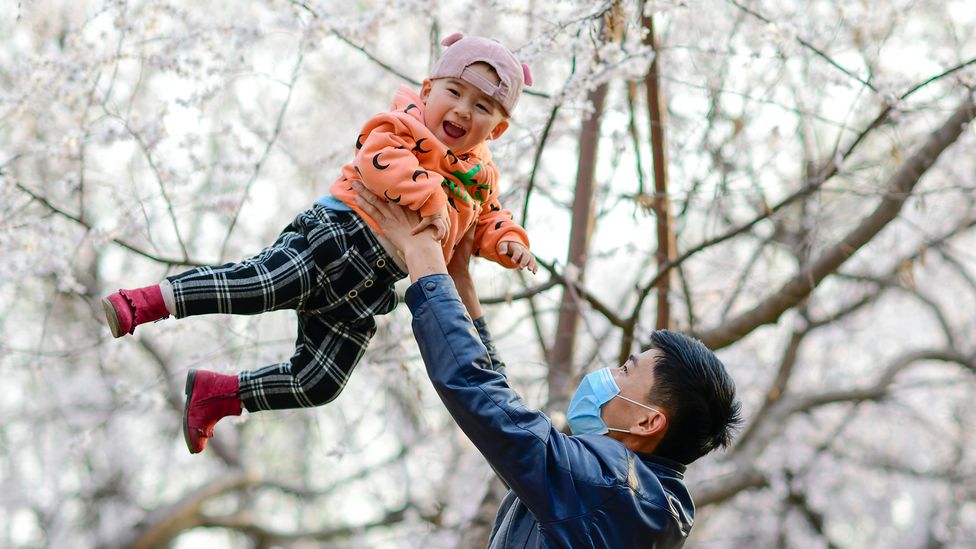
Some children honey boisterous play, while others adopt calmer interactions (Credit: Costfoto/Barcroft Media via Getty Images)
"Genetic influence affects about every measurable trait," explains Nancy Segal who specialises in twin studies at California Country University, Fullerton and is author of Deliberately Divided. For instance, a 2015 meta-analysis (a study of studies) looking at a combined total of 14 million twin pairs, either growing upwards together or raised apart, plant that identical twins raised apart were more than alike than fraternal twins raised in the aforementioned dwelling.
This confirmed what Segal had long noticed among twins she had met – that "shared environments do not make family members alike", she says. It's why she often says that parents of ane kid are environmentalists, whilst parents of two are geneticists, considering the latter quickly realise that two children raised in the same home tin can conduct in completely dissimilar ways.
Twin studies therefore reveal just how much behaviour is influenced by our genes. "And and so all of this parenting advice, which focuses merely on the parent, is really ignoring this bones, cardinal biological fact that our kids are not all blank slates. They all take their ain genetic dispositions," explains Dick. "Information technology means that dissimilar parenting strategies actually work ameliorate (or worse) for different types of kids."
Dick believes that despite a greater scientific agreement of the role of temperament shaping parenting, it withal hasn't hitting the mainstream. That's because if nosotros attribute certain behaviours or preferences to genetics, it can feel every bit though it diminishes our function as parents. Instead, though, we tin can reframe this insight to help us understand how much – or how little – parents shape their children's lives, every bit it takes abroad an element of perpetual self-arraign when children don't behave how nosotros expected them to.
It doesn't mean that parenting doesn't matter, it merely means how we parent depends on our children's temperament. Ane child may exist naturally outgoing and therefore enjoy a abiding stream of play dates. Another might respond well to more than solitary activities, meaning we are quieter around them. Ane child might love surprises, while a sibling may find them stressful and prefer gild and routine.
"Parents have the important and challenging responsibility of staying attuned to the kinds of behaviours that children limited and making sure they nurture them," says Segal.
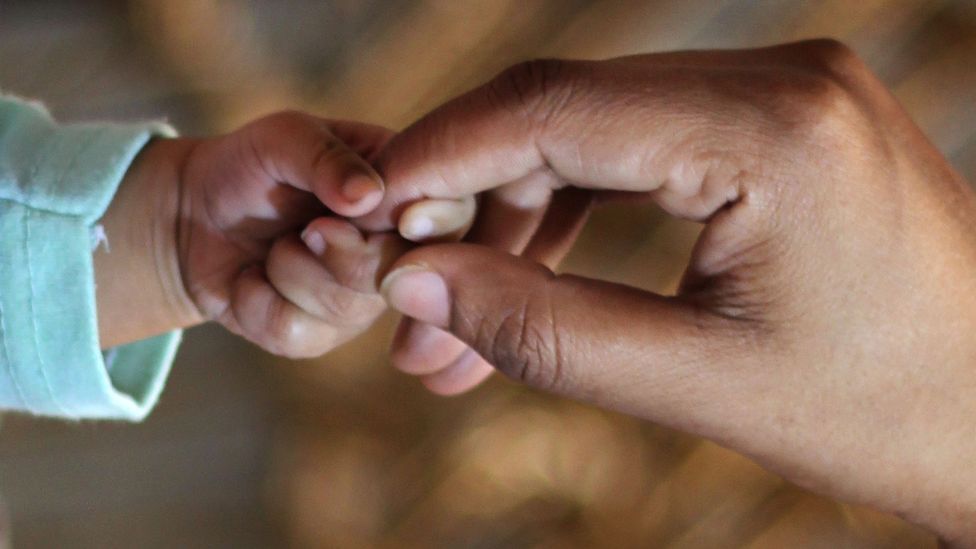
Reflecting on a child'southward personality can open new perspectives (Credit: Rana Sajid Hussain/Pacific Printing/LightRocket via Getty Images)
Staying attuned and mindful is not e'er like shooting fish in a barrel, however. Getting ii reluctant children dressed and prepare to exit the house, as one screams about the wrong socks or shoes, can trigger a stress response amongst even the calmest of parents, especially when trying to get to work on time. It'due south perhaps no surprise that inquiry shows that parents are more impatient than not-parents.
In such stressful situations, it tin can help to recognise that children have their ain sense of agency, meaning, they want to act freely, brand their own autonomous choices, and pursue their own goals and preferences. What nosotros may retrieve of as bad behaviour, may merely be a child expressing their sense of bureau. For parents, accepting that tin be challenging, for a number of reasons.
Psychologist Leon Kuczynski at the Academy of Guelph, who studies agency in children, points to a double standard: we wait children to exist compliant, only wouldn't expect that of an adult. "About of parenting is about how to deal with children's not-compliance, with the idea of suppressing it… From infancy, children's resistance is a sign of autonomy and that's actually a feature of [all] human beings," he says.
There is as well the practical difficulty of reconciling different goals. Even the most patient parent may struggle when their children's desires disharmonism with their own needs, such as leaving the house fully dressed, and on fourth dimension. Only while recognising children's sense of agency may not completely eliminate such stressful moments, it tin at least make parents feel more than aware of their kid's perspective – and less pressured to assert their authority.
As children get older, their influence on u.s.a. becomes more than obvious. In one 2016 study, Kuczynski and colleagues asked parents from 30 families to talk about whatsoever recent events where their children had intervened or had some influence in their lives. He plant a wide range of responses, from comments on a parent's advent, their politeness, their health and driving abilities. They fifty-fifty changed their recycling habits, with one parent of a ten-year-old saying: "Maybe we didn't believe in beingness environmentally friendly earlier he drew our attention to it."
Mothers experienced more influence than fathers, presumably because mothers tend to spend more time with their children overall. The study, explains Kuczynski, shows that while our actions affect the child, "the child's actions affect y'all. By existence in a shut relationship, you're really vulnerable and receptive to this kid's influence." It happens for good reason besides – parents reported wanting to "maintain a shut relationship" with their children, to amend intimacy and respect. Listening to them is conspicuously a primal part of that.
I was certainly a lot more patient and relaxed before I had children. Information technology helps to empathize that my children do not throw tantrums because I am impatient and stressed, but that I become more stressed when they scream. Simply they accept also taught me that empathising with their outbursts and validating their feelings, however irrational they may seem, is the best way to defuse such tantrums. Ultimately, nosotros are all learning from each other. Accepting this, and responding to their needs, makes life period more smoothly – even if information technology ways having that actress cup of java later another night of broken slumber.
---
Melissa Hogenboom is the editor of BBC Reel. Her book, The Maternity Complex , is out now. She is @melissasuzanneh on Twitter.
Source: https://www.bbc.com/future/article/20220104-how-parenting-changes-you
0 Response to "How a Family Cxan Shape U in Bad Situations in Life"
Post a Comment