What Movement Was Going on in Europe During the Art Assemblage Movement
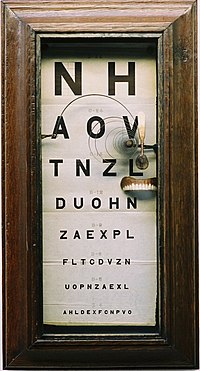
Aggregation is an artistic course or medium ordinarily created on a defined substrate that consists of three-dimensional elements projecting out of or from the substrate. It is like to collage, a two-dimensional medium. It is part of the visual arts and it typically uses found objects, merely is not limited to these materials.[1] [ii]
History [edit]
The origin of the art course dates to the cubist constructions of Pablo Picasso c. 1912–1914.[iii] The origin of the word (in its artistic sense) can exist traced back to the early on 1950s, when Jean Dubuffet created a series of collages of butterfly wings, which he titled assemblages d'empreintes. All the same, Marcel Duchamp, Pablo Picasso and others had been working with plant objects for many years prior to Dubuffet. Russian artist Vladimir Tatlin created his "counter-reliefs" in the mid 1910s. Alongside Tatlin, the earliest woman creative person to attempt her hand at assemblage was Elsa von Freytag-Loringhoven, the Dada Baroness. In Paris in the 1920s Alexander Calder, Jose De Creeft, Picasso and others began making fully iii-dimensional works from metal scraps, found metal objects and wire. In the U.S., one of the earliest and most prolific assemblage artists was Louise Nevelson, who began creating her sculptures from found pieces of wood in the late 1930s.
In the 1950s and 60s assemblage started to get more widely known and used. Artists similar Robert Rauschenberg and Jasper Johns started using scrappy materials and objects to make anti-aesthetic art sculptures, a large part of the ideas that make assemblage what information technology is.[four]
The painter Armando Reverón is one of the first to use this technique when using disposable materials such equally bamboo, wires, or kraft paper. In the thirties he fabricated a skeleton with wings of mucilage, adopting this style years earlier other artists. Later, Reverón made instruments and set pieces such as a telephone, a sofa, a sewing motorcar, a piano and even music books with their scores.
In 1961, the exhibition "The Fine art of Aggregation" was featured at the New York Museum of Modern Fine art. The exhibition showcased the work of early 20th-century European artists such every bit Braque, Dubuffet, Marcel Duchamp, Picasso, and Kurt Schwitters alongside Americans Man Ray, Joseph Cornell, Robert Mallary and Robert Rauschenberg, and too included less well known American W Coast assemblage artists such as George Herms, Bruce Conner and Edward Kienholz. William C Seitz, the curator of the exhibition, described assemblages every bit beingness made upwardly of preformed natural or manufactured materials, objects, or fragments non intended as fine art materials.[5] [6]
Artists primarily known for assemblage [edit]
- Arman (1928–2007), French artist, sculptor and painter.
- Hans Bellmer (1902–1975), a High german artist known for his life-sized female person dolls, produced in the 1930s.
- Wallace Berman (1926–1976), an American creative person known for his verifax collages.
- André Breton (1896–1966), a French artist, regarded equally a master founder of Surrealism.
- Huma Bhabha (built-in 1962), a Pakistani-American sculptor, known for her uniquely grotesque, figurative forms that oftentimes announced dismembered.
- John Chamberlain (1927–2011), a Chicago creative person known for his sculptures of welded pieces of wrecked automobiles.
- Greg Colson (built-in 1956), an American artist known for his wall sculptures of stick maps, constructed paintings, solar systems, directionals, and intersections.
- Joseph Cornell (1903–1972), Cornell, who lived in New York Metropolis, is known for his fragile boxes, usually glass-fronted, in which he bundled surprising collections of objects, images of renaissance paintings and old photographs. Many of his boxes, such equally the famous Medici Slot Automobile boxes, are interactive and are meant to be handled.[7]
- Rosalie Gascoigne (1917–1999), a New Zealand-born Australian sculptor.
- Raoul Hausmann (1886–1971), an Austrian artist and writer and a fundamental figure in Berlin Dada, his most famous work is the assemblage Der Geist Unserer Zeit – Mechanischer Kopf (Mechanical Head [The Spirit of Our Historic period]), c. 1920.
- Romuald Hazoumé (born 1962), a contemporary artist from the Democracy of Bénin, who exhibits widely in Europe and the U.M.
- George Herms (born 1935), an American artist known for his assemblages, works on papers, and theater pieces.
- Louis Hirshman (1905–1986), a Philadelphia artist known for his use of 3D materials on flat substrates for caricatures of the famous, as well equally for collages and assemblages of everyday life, archetypes and surreal scenes.
- Robert H. Hudson (built-in 1938), an American artist.
- Irma Hünerfauth (born 1907), a German artist, known for her combine paintings, collages and assemblages, bit sculptures, machines and kinetic art from constitute objects.
- Jasper Johns (born 1930), an American Pop artist, painter, printmaker and sculptor.
- Edward Kienholz (1927–1994), an American creative person who collaborated with his wife, Nancy Reddin Kienholz, creating free-standing, large-calibration "tableaux" or scenes of modern life such as the Beanery, complete with models of persons, made of discarded objects.[eight]
- Lubo Kristek (born 1943), a Czech creative person known for his disquisitional assemblages of bones, traps, textile cast out by the sea, waste and mobile phones (destructed in a happening).[nine]
- Jean-Jacques Lebel (born 1936), in 1994 installed a big assemblage entitled Monument à Félix Guattari in the Forum of the Centre Pompidou.
- Janice Lowry (1946–2009), American artist known for biographical art in the form of aggregation, artist books, and journals, which combined found objects and materials with writings and sketches.[10]
- Ondrej Mares (1949–2008), a Czech-Australian artist and sculptor all-time known for his 'Kachina' figures – a series of works.[xi]
- Markus Meurer (built-in 1959), a German creative person, known for his sculptures from found objects
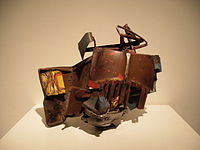
- Louise Nevelson (1899–1988), an American artist, known for her abstract expressionist "boxes" grouped together to form a new creation. She used found objects or everyday discarded things in her "assemblages" or assemblies, one of which was three stories high.[12]
- Minoru Ohira (born 1950), a Japanese-born artist.
- Meret Oppenheim (1913–1985), a German-born Swiss artist, identified with the Surrealist move.
- Wolfgang Paalen (1905–1959), an Austrian-German-Mexican surrealist creative person and theorist, founder of the magazine DYN and known for several assembled objects, f.e. Nuage articulé
- Noah Purifoy (1917–2004), an African-American visual creative person and sculptor, co-founder of the Watts Towers Art Eye, and creator of the Noah Purifoy Outdoor Desert Art Museum. He is best known for his assemblage sculpture, including a body of work fabricated from charred debris and wreckage collected subsequently the Watts Riots of August 1965.
- Robert Rauschenberg (1925–2008), painter and collagist known for his mixed media works during six decades.
- Fred H. Roster (born 1944), an American sculptor.
- Betye Saar (built-in 1926), American visual creative person primarily known for her assemblages with family memorabilia, stereotyped African American figures from folk culture and advertising, mystical amulets and charms, and ritual and tribal objects.
- Alexis Smith (born 1949) is an American artist all-time known for assemblages and installations.
- Daniel Spoerri (born 1930), a Swiss artist, known for his "snare pictures" in which he captures a group of objects, such as the remains of meals eaten by individuals, including the plates, silverware and glasses, all of which are fixed to the table or board, which is so displayed on a wall.[13]
- Vladimir Tatlin (1885–1953), a Russian artist known for his counter-reliefs—structures made of wood and iron for hanging in wall corners in the 1910s.
- Wolf Vostell (1932–1998), known for his use of concrete in his work. In his environments video installations and paintings he used boob tube sets and concrete as well equally telephones real cars and pieces of cars.
- Gordon Wagner (1915–1987), was a pioneer in American aggregation art, who was known for his boutique fine art, painting, poesy and writing.
- Jeff Wassmann (born 1958), an American-born contemporary artist who works in Australia nether the nom de plume of the pioneering German modernist Johann Dieter Wassmann (1841–1898).[14]
- Sara Rahbar (born 1976), sculptor, collagist, mixed media artist, all-time known for her flag series.
- Tom Wesselmann (1931–2004), an American Popular creative person, painter, sculptor and printmaker.
- H. C. Westermann (1922–1981), an American sculptor and printmaker.
- Jeffrey Vallance (born 1955), an American artist known for his assemblages, drawings, sculptures, paintings and conceptual art.
-
-
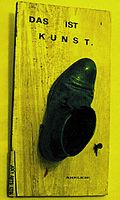
Werner Stürenburg, Nr. 5, 1968
See also [edit]
- Bricolage
- Collage
- Combine paintings of Robert Rauschenberg
- Decollage
- Mixed media
- Neo-Dada
- Unreadymade in Neomaterialism—run across Joshua Simon#Neomaterialism[xv]
References [edit]
- ^ Walker, John. (1992) "Aggregation Art". Glossary of Art, Architecture & Design since 1945, 3rd. ed. Retrieved Feb vii, 2012.
- ^ About.com fine art history Retrieved March 30, 2011
- ^ "The Drove | MoMA". The Museum of Modern Art.
- ^ Tate. "Assemblage – Art Term". Tate . Retrieved 2019-03-21 .
- ^ William C. Seitz, The Art of Aggregation, Doubleday (1962)
- ^ "The Art of Assemblage" (PDF). Museum of Modern Art. Retrieved 2018-05-27 .
- ^ Deborah Solomon, Utopia Parkway: The Life and Piece of work of Joseph Cornell, New York: Farrar, Straus & Giroux (1997).
- ^ Kienholz: eleven + 11 Tableaux, Moderna Museet, Stockholm, Sweden, northward.d.
- ^ Půtová, Barbora (2018). Chapters "Coming together Place – Introduction" Archived 2018-02-08 at the Wayback Machine, "Lubo Kristek: The Sun King in the Theatre of His Own Globe" and "Requiem for Mobile Telephones". Kristek Thaya Glyptotheque. Inquiry Establish of Advice in Art. ISBN 978-80-905548-three-ii. Retrieved February 7, 2018.
- ^ "A Finding Aid to the Janice Lowry papers, 1957-2009". world wide web.aaa.si.edu.
- ^ Galerie Gambit Pamphlet, Drury, Richard. (2000)
- ^ Biographical Note, The Louise Nevelson Papers, Athenaeum of American Art, Smithsonian Institution.
- ^ Wieland Schmied and Daniel Spoerri, Daniel Spoerri: Coincidence equally Chief = Le Hasard comme maître = Der Zufall als Meister = Il caso come maestro, Bielefeld, Germany, 2003 at p. 10.
- ^ Crawford, Ashley. "Hoax most perfect," Melbourne Historic period, Oct 11, 2003.
- ^ "Frontpage".
Farther reading [edit]
- William C. Seitz: The Art of Assemblage. Exhib. October four - November 12, 1961, The Museum of Modern Art, New York, 1961.
- Stephan Geiger: The Art of Assemblage. The Museum of Mod Art, 1961. Die neue Realität der Kunst in den frühen sechziger Jahren, (Dissertation Universität Bonn 2005), München 2008, ISBN 978-iii-88960-098-i
- Sophie Dannenmüller: "Un point de vue géographique: 50'assemblage en Californie", in L'art de l'assemblage. Relectures, sous la direction de Stéphanie Jamet-Chavigny et Françoise Levaillant. Presses universitaires de Rennes, drove "Art & société", Rennes, 2011.
- Sophie Dannenmüller: "L'assemblage en Californie: une esthétique de subversion", in La Fonction critique de l'art, Dynamiques et ambiguïtés, sous la direction de Evelyne Toussaint, Les éditions de La Lettre volée / Essais, Bruxelles, 2009.
- Sophie Dannenmüller: "Bruce Conner et les Rats de 50'Art", Les Cahiers du Musée national d'art moderne, Editions du Centre Pompidou, Paris, north° 107, avril 2009, p. 52-75.
- Simon, Joshua: Neomaterialism, Berlin: Sternberg Press, 2013, ISBN 978-three-943365-08-5
- Tatlin, Vladimir Evgrafovich "Counter-relief (Material Assortment)" - WebCite query result
Source: https://en.wikipedia.org/wiki/Assemblage_%28art%29
0 Response to "What Movement Was Going on in Europe During the Art Assemblage Movement"
Post a Comment